An unfiltered selection updates after each conversion for fastest response, up to 60/sec, while integrating the input signal over a full power cycle. Fast read rate provides true peak readings and aids in control applications.
A batch average filter selection averages each 16 conversions for an update every 1/4 sec.An adaptive moving average filter selection provides a choice of 8 time constants from 80 ms to 9.6 s. When a significant change in signal level occurs, the filter adapts by briefly switching to the shortest time to follow the change, then reverts back to its selected time constant. Another choice is Auto, which provides an automatic time constant selection based on the signal noise characteristics.
With the coordinate reading method, the meter reads the high and low signal values, and the user enters the desired high an low reading values. The meter then calculates the span multiplier and offset. This method is ideal if an external calibration reference is available.
With the manual coordinate method, the user enters the high and low input values in Volts plus the desired high and low reading values. This method is suitable if an no external calibration reference is available.| DC Microvoltmeter Inputs | Input Range mV |
Resolution | Error at 25°C | |
| ±20.000 | 1.0 µV | |||
| ±50.000 | 2.5 µV | |||
| ±100.00 | 5.0 µV | 0.01% FS | ||
| ±250.00 | 12.5 µV | ±1 count | ||
| ±500.00 | 25 µV | |||
| Load Cell Inputs | Full-Scale Input, mV |
Zero Adjust |
Span Adjust |
Error at 25°C |
| ±20.000 | -99,999 to +99,999 |
0 to ±99,999 |
0.01% FS ±1 count |
|
| ±50.000 | ||||
| ±100.00 | ||||
| ±250.00 | ||||
| ±500.00 | ||||
| Accuracy | Noise Rejection | ||
| Span Tempco | 0.0015% of reading/°C |
CMR, DC to 60 Hz |
130 dB |
| Zero Tempco | 0.1 µV/°C | NMR at 50/60 Hz | 90 dB with min filtering |
| A-to-D Conversion | Display | ||
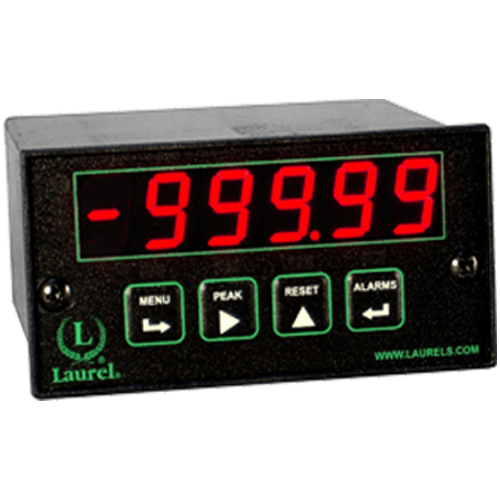
| Technique | Concurrent Slope™ (Pat 5,262,780) | Readout | 5 digits, 7-segment, 14.2 mm (.56") |
| A-to-D Rate | 60/s at 60 Hz, 50/s at 50 Hz | Color | Red or green LED |
| Output Update | 56/s at 60 Hz, 47/s at 50 Hz | Range | -99999 to +99999 or -99990 to +99990 (count by 10 with rounding) |
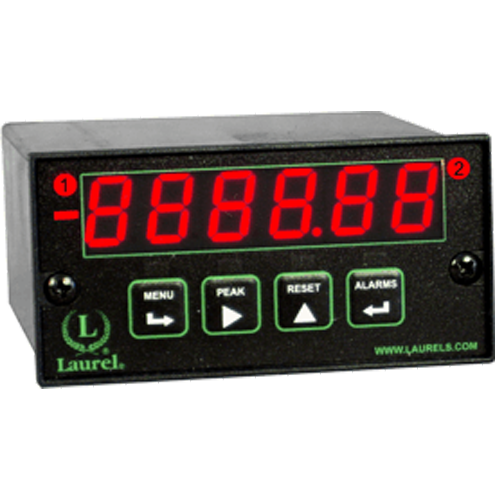
| Display Update | 3.5/s at 60 Hz, 3/s at 50 Hz | Indicators | Minus sign, 2 red LED lamps |
| Power | Excitation Output | ||
| Voltage, std | 85-264 Vac and 90-370 Vdc | 5 Vdc | 5 Vdc ±5%, 100 mA max |
| Voltage, opt | 8-28 Vac and 9-37 Vdc | 10 Vdc | 10 Vdc ±5%, 120 mA max |
| Frequency | DC or 49-440 Hz | 24 Vdc | 24 Vdc ±5%, 50 mA max |
| Power isolation | Safety-rated to 250 Vac, meter ground to earth ground, DC to 60 Hz, 4.2 kVp per High Voltage Test |
Output isolation | 50 Vdc to meter ground |
| Environmental | |||
| Operating Temperature | 0°C to 55°C | ||
| Storage Temperature | -40°C to 85°C | ||
| Relative HumidityProtection | NEMA-4X (IP-65) when panel mounted | ||
![]() |
In 4-wire connection, the excitation and sense lines are tied together. The meter can make ratiometric corrections for supply voltage variations, but not compensate for variations in lead resistance. This connection is often used with short cable runs. | ||
![]() |
In 6-wire connection, the sense lines are separate from the excitation lines, thereby eliminating effects due to variations in lead resistance. This allows long cable runs in outdoor environments with temperature extremes. | ||
![]() |
For large scales, up to four 350 ohm load cells can be powered by a single Laureate, whose excitation output is rated 120 mA at 10 V. The excitation and sense points of the four bridges are connected in parallel through a summing box. |
![]() |
Auto-Tare
To read the net weight of an object, the empty container is first weighed, and an external button is pushed to zero out the display. The meter will then read net weight when an object is added to the empty container. The tare value is stored in memory for subsequent readings. |
||
![]() |
Determining Volume Using Load Cells
An easy way to determine volume of an irregularly shaped tank with no need for linearizing is to weigh the tank using load cells. The meter will automatic- ally tare out the weight of the empty tank and then scale the load cell signals to units of volume, such as gallons. |
||
![]() |
Peak Capture for Testing the Tensile Strength of Wire
Peak readings are automatically captured at rates up to 60 per second, while the display updates at a legible 3.5 per second. The peak reading can be recalled at the push of a button or be always displayed. It can also be transmitted to a computer via RS-232 or RS-485. |