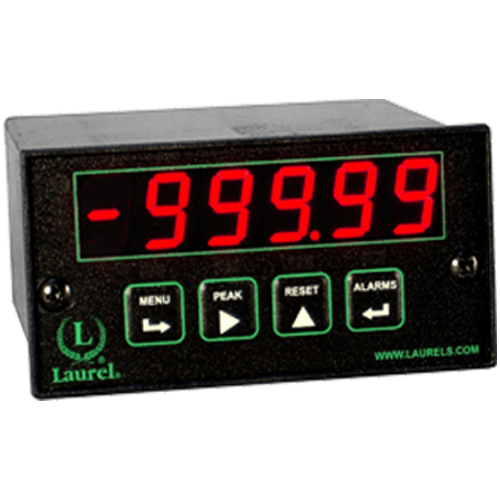
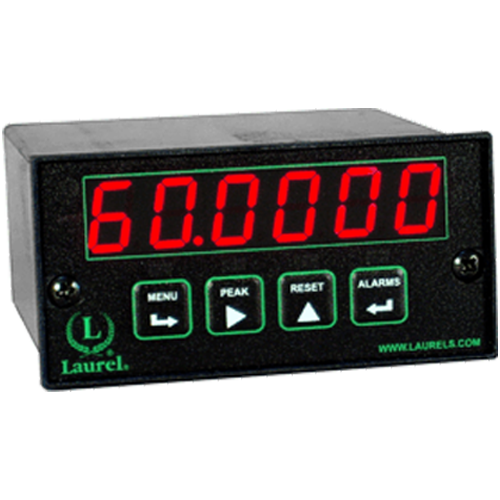
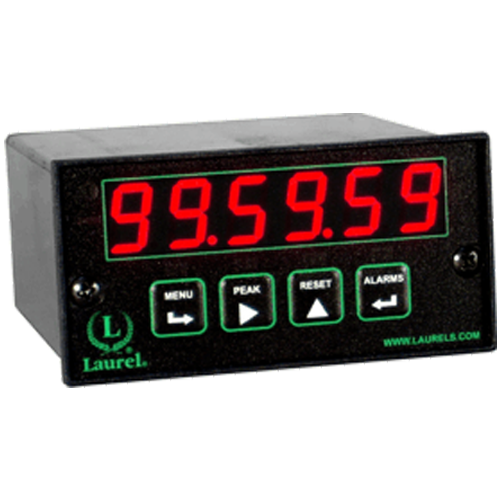
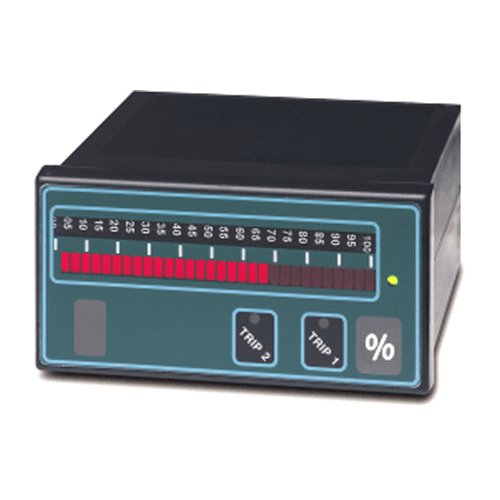
Laureate™ Time Interval & Stopwatch Meters
(For periodic time measurement & one-time events)
Features
Common Features
- Certified to UL 3101-1, CAN/CSA-C22.2, EN 61010-1 (CE Mark).
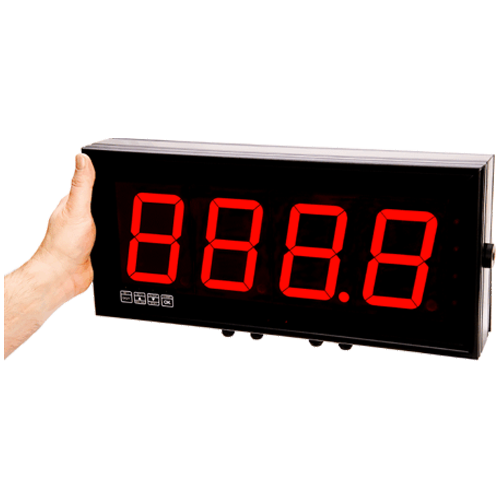
- 6-digit red or green LED display
- Green or red LED display.
- Dual 10A relays 4-20 mA & 0-10 V analog output
RS-232/485 data I/O , Parallel BCD output.
- Trigger on positive or negative pulse edges.
- Isolated 5, 10 or 24 Vdc excitation output to power sensors.
- NEMA 4X front panel, 1/8 DIN case.
- Inputs from NPN or PNP proximity switches, contact closures, digital logic, magnetic pickups down to 12 mV, or AC inputs up to 250 Vac.
Time Interval Mode
- For periodic events from 1 µs to 199.99 s.
- Uses Standard counter main board and FR signal conditioner.
- Display resolution to 0.2 µs.
- -----------
Stopwatch Mode
- Times single events with start and stop pulses from 1 ms to 99 hrs.
- Selectable display in HH.MM.SS clock format or H, M or S up to 6 digits with decimal point.
- Selectable display of single event time or accumulated time of all events up to 999,999 hrs.
- Uses Extended counter main board and FR signal conditioner.
Description
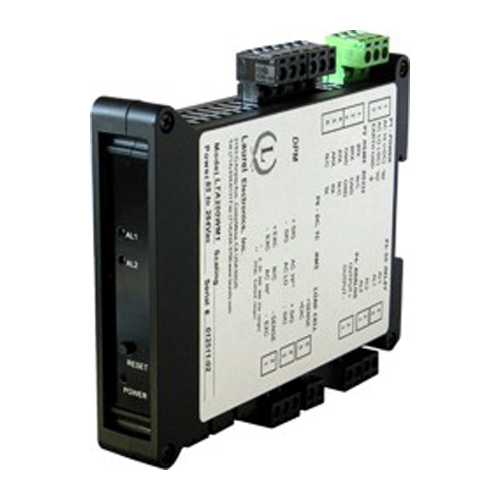
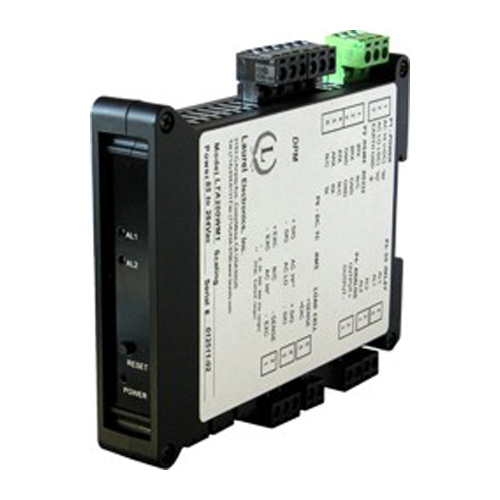
The Laureate™ time interval and stopwatch timers use the FR dual-channel signal conditioner and either the Standard counter main board (time interval) or Extended counter main board (stopwatch).
A-B Time Interval Mode
The Laureate time interval meter displays pulse width or time delay between pulses for single pulses or the average for multiple pulses. Time interval is measured between inputs on channels A and B. Timing starts when a pulse is applied to Channel A (selectable positive or negative edge) and ends when a pulse is applied to Channel B (selectable positive or negative edge). In case of a single pulsed signal, the A and B inputs can be tied together. A positive or negative slope may be selected to start timing, and the opposite slope must be selected to stop timing.
Timing is achieved by counting 5.5 MHz clock pulses. Multiple integral time intervals are averaged over a gate time which is selectable from 10 ms to 199.99 s and also controls the display update time. The default display is in µs. Display resolution down to 0.2 µs can be achieved by applying a multiplier of 10, moving the decimal point by one position, and averaging many time intervals. Resolutions up to 1 s or greater are also programmable.
Stopwatch Mode
The Laureate stopwatch meter is designed to time single events, such as sporting events or processes, which produce start and stop pulses. It can also time the width of a single pulse. The display is updated continuously during timing.
A-A Stopwatch Mode. Time can be measured between a start pulse and a stop pulse, both on Channel A, from either the positive or negative edges
A-B Stopwatch Mode. Time can also be measured between a start pulse on Channel A (positive or negative edge) and a stop pulse on Channel B (positive or negative edge). This mode allows inputs from different sources. In addition, the A and B inputs can be tied together to start the stopwatch with one polarity and stop it with the other polarity.
Display
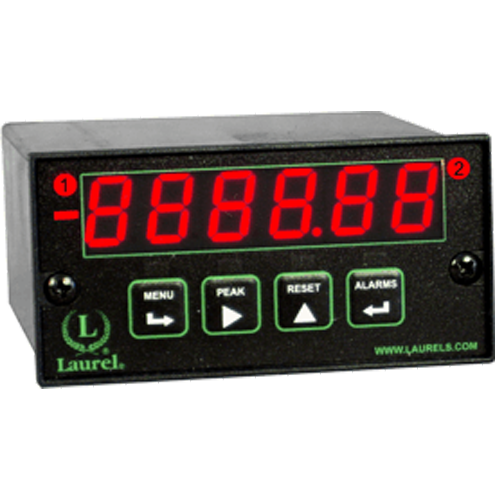
The event time (Item #1) may be displayed in HH.MM.SS clock format with 1 s resolution or in H, M or S seconds with six-digit resolution . The longest timing interval is 99 hours. The highest resolution is 1 ms.
The stopwatch display is updated during timing at a rate controlled by gate time, up to 25/s. It is reset to zero when the next start pulse occurs. Accumulated time from multiple events (Item #2) is also tracked and may be displayed up to 999,999 hours.
Universal Signal Conditioner
The dual-channel signal conditioner used for pulse detection accepts inputs from proximity switches with PNP or NPN output, TTL or CMOS logic, magnetic pickups, contact closures, and other signals from 12 mV to 250 Vac. Nine hysteresis and input levels are jumper selectable for reliable triggering. A 1600 Hz low-pass roll-off filter for noise reduction and contact debounce times of 3 ms or 50 ms are also selectable.
A built-in isolated 5, 10, or 24 Vdc excitation supply can power proximity switches and other sensors, and eliminate the need for an external power supply.
Other Features and Options
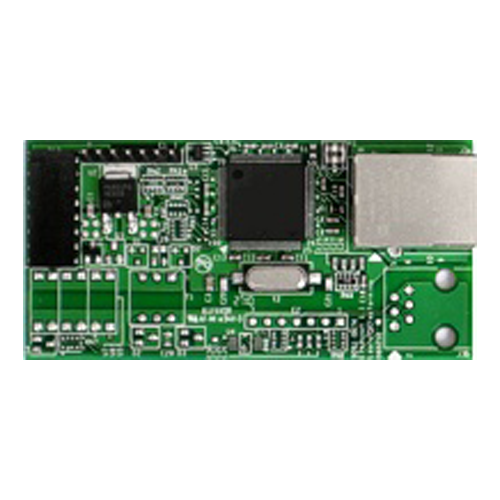
Plug-in isolated analog output, dual setpoint controller and RS232/485 communications or BCD output boards can upgrade the Laureate from a stand-alone monitor to system interface and control. Laureate meters and counters meet NEMA 4X (IP-65) standards from the front for high pressure washdown when panel mounted. All power and signal connections are via plug-in screw-clamp connectors.
Specifications
| Display |
Excitation Output |
| Readout |
6 digits, 7-segment, 14.2 mm (.56") |
5 Vdc |
5 Vdc ±5%, 100 mA max |
| Color |
Red or green LED |
10 Vdc |
10 Vdc ±5%, 120 mA max |
| Range |
-99999 to +99999 |
24 Vdc |
24 Vdc ±5%, 50 mA max |
| Indicators |
4 red LED lamps |
Output isolation |
50 Vdc to meter ground |
| Electrical Connections |
Time Interval Mode |
 |
Timing Start |
Channel A pulse, + or - edges |
| Timing Stop |
Channel B pulse, + or - edges |
| Periodic Timing Interval |
Gate time + 30 ms + 0-2 time intervals |
Gate Time
|
Selectable 10 ms to 199.99 s |
Timeout
|
Same as periodic timing interval |
| Environmental |
Power |
| Operating Temperature |
0°C to 55°C |
Voltage, std.
|
85-264 Vac and 90-370 Vdc
|
| Storage Temperature |
-40°C to 85°C |
Frequency
|
DC or 49-440 Hz
|
| Relative Humidity |
95% at 40°C, non-condensing |
Voltage, opt. |
8-28 Vac and 9-37 Vdc
|
| Protection |
NEMA-4X (IP-65) when panel mounted |
Power isolation |
Safety-rated to 250 Vac, meter ground to earth ground,
DC to 60 Hz, 4.2 kVp per High Voltage Test |
| Inputs |
Types
|
AC, pulses from NPN, PNP transistors, contact closures, magnetic pickups |
Selectable Hysteresis |
(-12 mV to +12 mV), (+30 mV to +60 mV),
(-30 mV to -20 mV), (-150 mV to +150 mV),
(+350 mV to +600 mV), (-600 mV to -350 mV),
(-1.15 V to +1.15 V), (+1.25 V to +2.1 V),
|
| Grounding |
Common ground for channels A & B |
| Channel A Frequency |
0.005 Hz to 1 MHz |
Rolloff Filter |
(-2.1 V to -1.25 V) |
| Channel B Frequency |
0.005 Hz to 250 kHz |
Debounce Time |
Selectable, none or 1600 Hz
Selectable 0, 3, 50 ms |
| Stopwatch Mode |
Accuracy |
| Timing Start |
Channel A start pulse, + or - edge
|
Time Base
|
Crystal calibrated to ±2 ppm |
Timing Stop
|
Channel A stop pulse, same edge polarity as start pulse,
or Channel B pulse, opposite edge polarity as start pulse. |
Span Tempco
|
±1 ppm/°C (typ)
|
| Timing interval |
1 µs to 99 hrs |
Long-term Drift |
±5 ppm/year |
| Timing Resolution |
1 µs |
| Selectable Decimal Time |
999999 H, M or S, any decimal point |
| Selectable Clock Time |
HH.MM.SS |
| Output & Display Update |
Gate time |
Typical Applications
Time Interval Mode for Time Delay
The stopwatch mode is used to time single events between start and stop pulses on the same channel. Duration of a single waveshape can be measured by tying the A and B channels together.
Time Interval Mode for Pulse Width
The start and stop pulses used for timing can be generated by the dual relay board in a Laureate analog panel meter or digital counter. For instance, the start and stop pulse edges can be created as temperature passes two alarm setpoints, or temperature cycles in a hysteresis control mode.
Replacing an Oscilloscope with a Laureate
An oscilloscope can be used for viewing pulses. However, a Laureate time interval meter is the instrument of choice if high timing accuracy or control outputs are required.
Stopwatch Mode
For periodic pulses applied to A and B channels, time delays can be measured down to 0.2 µs resolution from the rising or falling edge of A to the rising or falling edge of B (selectable).
Timing Process Dynamics
The width of periodic pulses (t1 or t2) can be measured by tying the A and B channels together. As for time delay, readings are averaged over a user-selectable gate time.
Instrumenting a Pulsed Laser System
Some of the many possibilities in instrumenting a pulsed laser system with Laureate dual-channel counters.
5672 Bolsa Avenue Huntington Beach, CA 92649 - USA - Ph (714) 751 - 7512 - Fax (714) 751 - 0213